

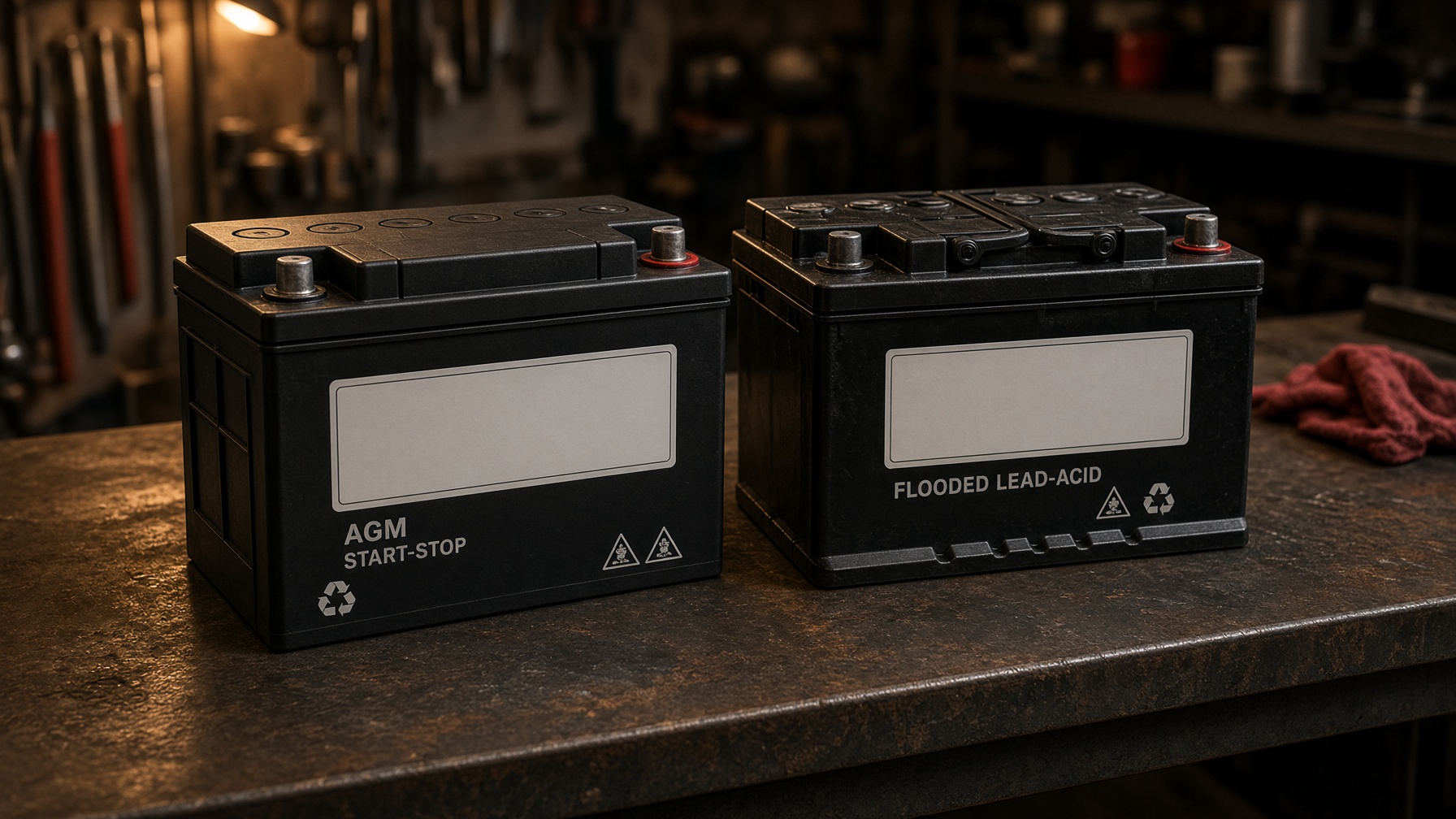
Ford battery and start-stop in Dubai is why a two-year battery can be a full life. Territory, Explorer, Mustang and some Rangers use AGM or EFB when the car was built for stop-start. Heat cooks plates. Short trips never recharge properly. A flooded battery in an AGM tray is how you buy two batteries and a warning light that will not die.
Load-test first. Many “dead Fords” are an alternator, a parasitic drain, or a dirty earth. Fitting gold-plated AGM on top of that is still a jump-start next week.
AGM versus flooded
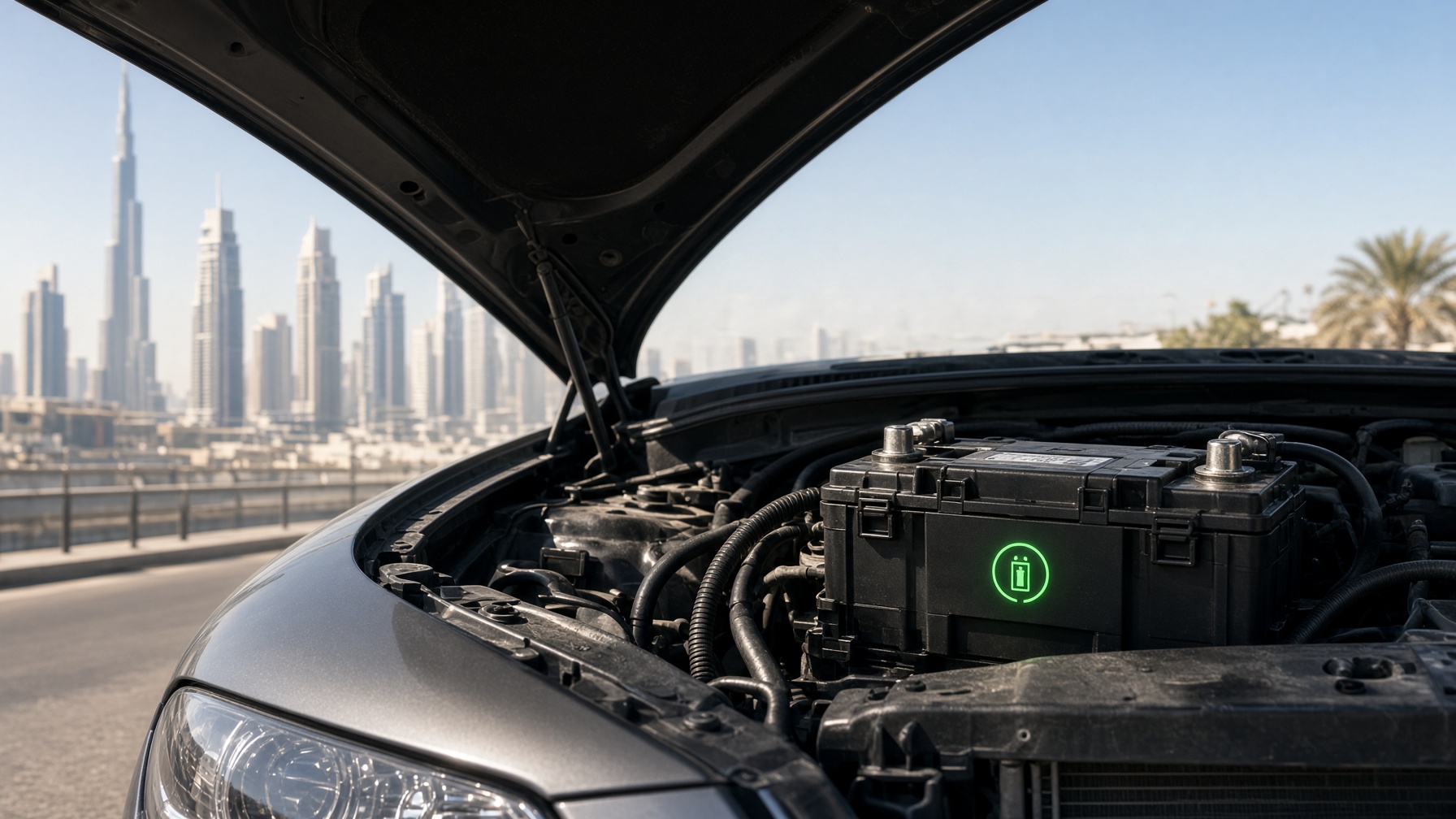
Stop-start Fords want AGM or the EFB the tray was designed for. The charging logic expects that internal resistance. A cheap flooded cube will crank for a month and then sulk. Explorer and Territory school-runs are classic: the car never gets a highway charge, the start-stop system gives up, the battery is blamed for a software light that was the wrong spec all along.
Mustangs that sit in a basement six days need a battery that can take heat and a trickle if you can. Site Rangers that idle need CCA and a test under load, not a pretty label.
What we test
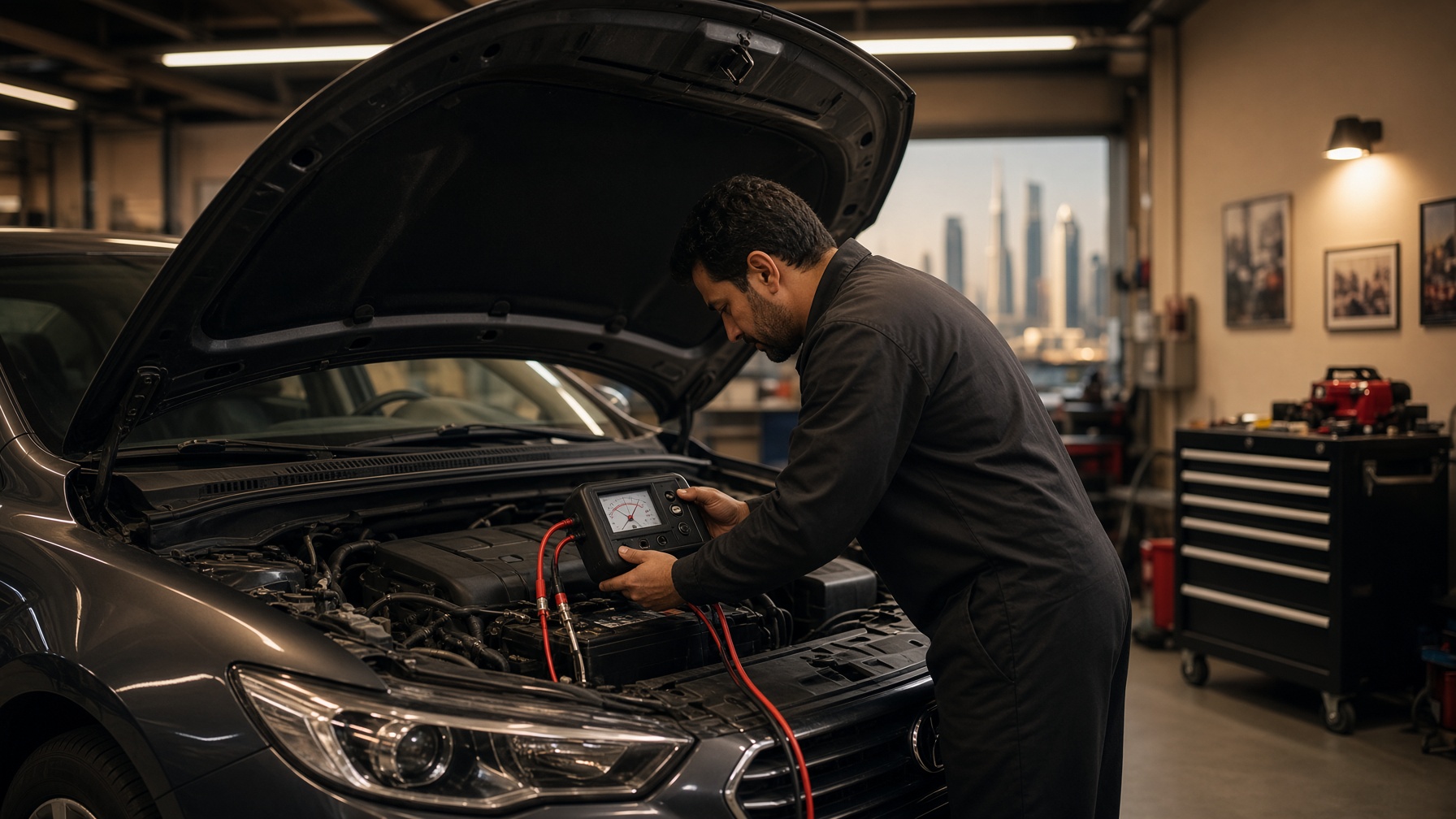
Open-circuit voltage, load test, charging voltage with AC and lights on. Terminals cleaned, not painted over. Drain test if a new battery went flat overnight — glovebox, dashcam, aftermarket tracker. Registration or stop-start reset when the model needs it. Leaving that out is why a new battery still throws a message.
Date-stamp the fit. Keep the reading. If it dies in three months we have a paper trail that points at charge or drain, not at “bad luck.”
Heat calendar

Test before June. Replace on a fail, not on a round number of years. Two summers is a fair life for many under-bonnet Fords here. Three is a bonus. Five is a European story. Pair the test with AC before peak summer; the clutch and fans are what finish a weak battery at a red light.
Territory and Taurus volume cars are the ones we see most for this. Explorer stop-start is next. Mustang sitters after that. The chemistry is the same. The tray size is not. We fit what the tray says, not what was in the delivery van.
When it is not the battery

Slow crank with grinding can be a starter. No crank with full lights can be an earth or a starter still. A van that dies while idling can be an alternator. We test before we sell. Battery and AC live on the same hot day: car battery replacement in Dubai and car AC repair in Dubai.
Vesla, Ras Al Khor. Send the model and whether it is stop-start, a sitter, or a site idler. We will not put flooded in an AGM Ford, and we will not skip the load test because you already bought a battery from a kiosk.
Stop-start that never engages is often a battery that is already tired, a bonnet switch, or a cabin that is too hot for the system’s comfort logic. People chase sensors. We test the battery first because it is cheap and often right. If the battery is good, then we chase the switch and the scan.
Dashcams that are always on, trackers, and poor aftermarket installs are the parasitic drain hall of fame. If a Ford dies overnight after a new battery, we do not fit a third battery. We measure milliamps with the door closed and the car asleep. That test takes patience. It saves money.
Explorer hybrids and unusual trims are not this article. If your cluster says hybrid, say so. The battery in the boot is not the under-bonnet AGM. Wrong test, wrong quote.
Storage: if the Mustang or the second Ranger sits two weeks, a trickle charger in a ventilated place is cheaper than an AGM every spring. Heat plus a flat sit is plate sulphate. We can load-test. We cannot reverse a battery that was left dead in August.
Fit quality: terminals tight, coded if required, idle stop checked in a road test. A battery that is only “in” is half a job. The other half is the car agreeing that it is an AGM and that start-stop may work again. That is the line on the invoice.
Group size and CCA: the tray is the law. A smaller battery with a big CCA number on a sticker is still a smaller battery. We fit the size Ford left room for. Side terminals, hold-downs, vent tubes — the boring bits prevent a battery that walks in the tray and eats a bonnet stay.
Jump-start damage: reverse clamps on a Mustang in a hotel basement is how you buy a module. If the car is dead, say so; we bring a pack and we do not guess polarity in the dark. After a bad jump, a load-test is not enough. We scan.
Warranty on batteries is heat-limited in this city whether anyone prints it. Keep the receipt. Keep the test. That is how a three-month death becomes a charge-system job instead of a shrug.
Territory start-stop in mall traffic: the system gives up when the cabin is an oven and the battery is already at 60 percent. Owners think the car is broken. Often the battery is tired and the condenser is packed, so the car refuses to kill the engine because it needs the compressor. Fix those two before you hunt a start-stop module.
Mustang GT with a big idle-off: many owners disable start-stop. Fine. The battery is still an AGM in many cars. Fit the spec. Disabling a feature does not turn the tray into a taxi flooded cube.
Disposal: we take the old unit. Do not leave acid in a compound basement. That is the whole environmental paragraph.
If start-stop still refuses after a correct AGM and a reset, we scan for the reason the car is protecting itself — cabin temp, angle, bonnet switch, low charge. Replacing a second battery without that scan is how kiosks eat Fords.

Comments are closed